

Blog
Get Pay Right on ADP Workforce Now® Next Gen™
Bringing trusted compensation intelligence and seamless planning to even more ADP users.
Written by Salary.com Staff
April 10, 2026

With rising labor and talent costs, employers face the challenge of creating more robust employee compensation packages to meet the growing needs of their employees.
The 2026 Salary Budget Planning Survey by WTW has revealed that U.S. organizations plan for steady salary increases of 3.4%. This is a more stable market for compensation professionals to look into the equity, benefits, and bonuses that many employers overlook but add significant value to the employee.
This article will discuss the total compensation value for employers and employees its components and strategies to implement, and how to calculate it for your employees.
Total compensation is the value of the complete package that an employer offers to the employee for their work. Several elements go beyond the paycheck or salary that employees receive.
From monetary to non-monetary rewards and incentives, total comp refers to the value that the employer provides in exchange for the employee’s work.
For the HR or compensation professional, total compensation is the critical figure that every organization needs to attract skilled workers in this challenging market. This figure will also give you a better idea of how to budget these payments and foster transparency between your employees and employer.
Additionally, this figure will give you an idea of how much pay equity you are abiding by.
The 2025 New York City Council bill on pay equity mandates that companies with 200 or more employees report their pay data annually. This will highlight any disparities in pay by gender, race, or ethnicity to ensure pay fairness. The total comp figure will help you foster this fairness in pay between workers doing similar jobs.
Employees who see the bigger picture of what their employer pays will feel more valued, and this will improve your organization’s staff retention rate.
There are several components to total compensation. They include:
Base pay
Variable pay
Benefits
Equity
Each of these components plays a vital role in ensuring that your employees’ needs are met while they contribute their best work to your business. Generally, total comp figures will include both direct and indirect pay as part of these components.
To design base pay for total compensation, follow these four steps:
Define philosophy
Evaluate roles
Benchmark & build ranges
Audit for equity
Companies use a salary structure to build a framework that will help them determine the base pay they will offer their employees. This structure will indicate the minimum and maximum amount that a company may offer employees in certain roles.
It will also include a midpoint that features the median salary offered for the same job role in a specific industry or geographic region.
As an HR or compensation practitioner, you can build this salary structure using several steps to ensure that you capture all the required information.
Defining job families and sets and using market research to determine salary ranges are just some of the steps you can use to build this salary structure.
The outcome of the job evaluation will help you determine their salary structure placement, which will impact their base pay. Job evaluations use techniques like point-factor systems that assess different factors like skills, effort, responsibility, and more to assign job rankings within an organization.
Market data analysis is another important factor in determining an employee’s base pay. As part of the job evaluation, you must analyze salary survey data that you sourced from salary surveys from organizations like Salary.com.
These sources will help you ensure that your base pay is competitive in your sector. The results will ensure that you don’t underpay your employees or lose talent to other organizations offering better pay for the same workload.
Market Pricing offers market pay data to price jobs and compare internal pay to external benchmarks. It directly supports market data analysis and salary benchmarking when setting base pay and building competitive salary ranges for total comp.
In a pay equity analysis, you look at your total comp package to find any discrepancies in the package offered to employees across similar job roles.
If you find any discrepancies that may cause gender or race disparities in pay, you can swiftly act to balance these differences. This allows you as the HR or compensation professional to foster fairness in your employee workforce.
Regression & Cohort Analysis directly supports pay equity analysis by statistically identifying the drivers of pay gaps within total comp.
Beyond the variable pay, your employees will also require several benefits to function optimally at work. You can integrate these into a total comp package to foster employee satisfaction.
Employers typically offer health insurance programs as part of the benefits that they offer in their total comp packages. By offering to pay for health costs like hospital bills or doctor visits under a group plan premium that they pay for, employers significantly increase the value of their offers in terms of health benefits.
Retirement plans like 401(k) contribute significantly to your total comp package as they offer long-term value that assures your employees of financial security after retiring from active employment.
Now that you know what goes into a total comp package, let’s take a look at how you can calculate it using several steps.
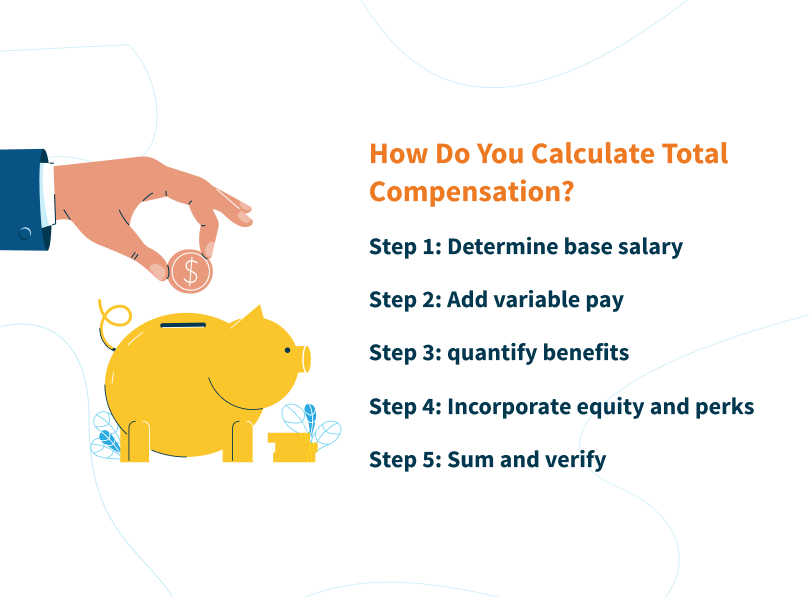
The first step is determining an employee’s base salary or the annual fixed amount that they will earn with no bonuses.
After determining base pay, you will have to add in any extra monetary bonuses that your employee will earn from commissions or overtime.
Here, you have to put a value on many of the non-monetary elements such as health insurance coverage, retirement savings, and paid time off.
Finally, factors like stock options or membership perks matter too, so make sure that these are a consideration when calculating total comp.
After adding all of these together within the total comp formula below, it would be best to review your results against market data to ensure competitiveness.
Total Compensation = Base Salary + Bonuses/Commissions + Value of Benefits + Equity
Example calculation
To put this into perspective for better understanding, here is a practical example. Let’s assume:
Base salary: $100,000
Bonus: $10,000
Health insurance (employer paid): $8,000
401(k) match: $3,000
Your total compensation comes out to: $100,000 + $10,000 + $8,000 + $3,000 = $121,000
Total Compensation Statement directly supports the calculation and presentation of total comp by consolidating base pay, variable pay, benefits, and equity into a standardized total comp statement.
As a compensation professional and HR practitioner, you know that implementing a total comp strategy requires different stages and throughputs. Here is a four-step process for this.
Define strategy & goals: Determine your organization's mission and whether you intend to lead, lag, or match the market in pay.
Conduct research: Perform job analysis to define roles and use salary surveys to benchmark them against competitors.
Design the package: Balance direct pay (base salary, bonuses) with indirect pay (health insurance, 401(k), PTO, and perks) while setting clear salary ranges for each role.
Communicate & review: Clearly explain the value of the "total package" to employees using total comp statements and regularly audit the plan for legal compliance and market shifts.
Market benchmarking is an effective way to ensure that your current total comp packages are competitive and closely aligned with industry standards. Using salary surveys will allow you to keep up with your competition.
Several tools help organizations benchmark pay and adjust total comp based on market movements. Compensation Software, enables HR and compensation teams to price jobs using market pay data and compare internal roles against external benchmarks so salary ranges, pay adjustments, and total comp decisions remain competitive and aligned with current market conditions.
Internal equity means ensuring that all employers with a similar skill level enjoy the same rewards for their effort within an organization. By conducting a thorough auditing process, you can enjoy internal equity.
Here are the common questions about the topic:
Total comp includes base salaries plus bonuses plus benefits plus perks. All monetary values are included.
Total comp refers to a broader category of elements than base salary which is the main element of total comp.
A statement of total comp is a document that lists all the monetary values included in the above total comp formula. This statement also features a sum of the values for transparency.
Yes! All monetary values even if with vesting schedules will always be included in total comp calculations!
To ensure fairness and abide by regulations, it is best for organizations to constantly review this figure annually or as needed due to market fluctuations!

The latest research, expert advice, and compensation best practices all in one place.
Blog
Bringing trusted compensation intelligence and seamless planning to even more ADP users.

Blog
Learn how to train managers for effective pay conversations and build trust.

Blog
Total rewards package flexibility lets employees choose what matters - pay, perks, and benefits tailored to their needs.