

Blog
Get Pay Right on ADP Workforce Now® Next Gen™
Bringing trusted compensation intelligence and seamless planning to even more ADP users.
Written by Salary.com Staff
April 10, 2026

Phantom equity is an intelligent form of compensation for companies that want to retain top talent without giving away actual shares. Instead, it ties cash compensation to company growth, which ensures employee goals are in line with that of the business.
This guide details phantom equity's definition, advantages, types, how-to set-up, how-to manage, and FAQs for HR professionals.
Phantom equity also known as phantom stock, phantom units, or phantom shares, is a form of non-stock shareholder compensation wherein employees receive cash payment based on the performance of shares without actually becoming stockholders.
Phantom stock allows employees to benefit from appreciation in value should the company be sold or taken public while simultaneously making a promise to employees that they will benefit from such transactions if the business performs well. For HR professionals, phantom stock is a way to cultivate loyalty without equity transfer.
There are no voting rights or dividend payments from actual shares.
Known as phantom stock or phantom units, this focuses on value.
It's the best option for private companies that would otherwise complicate matters with potential complete equity awards.
Compensation Software helps organizations benchmark compensation and ensure phantom stock awards remain competitive and aligned with market pay levels, preventing over- or under-valuation of incentive compensation.
Phantom equity awards are based on phantom units given to employees that align with actual stock value. Thus, when an employee is given phantom shares, the number corresponds to actual share value at a vested time (e.g., four years) and when a triggering event occurs (e.g., buyout), they must receive cash equivalent of the value of the unit.
Much like a stock option, the pay-for-performance nature of these awards ties compensation to business output without diluting ownership or creating conflicting voting interests.
For instance, if an employee is given 100 units valued at $10 each, and the appreciation increases the value to $50, the payout could be a net $4,000 (based only on appreciation from the original valuation).
Compensation Planning enables organizations to manage incentive compensation programs, including equity-like rewards such as phantom stock, by tracking allocations, performance alignment, and future payout planning.
Companies use phantom stock plans to incentivize employees to work for increased cash compensation without diluting shareholder percentages. The business retains control and ownership, and employees can reap the rewards of increased valuation.
This is especially important for start-ups or private companies looking to attract talent during talent wars. Furthermore, turnover can be reduced with cash awards translating into long-term wins.
For example, Carta data indicates that by 2024, nearly 61% of initial equity grants to management teams at private equity–backed companies included performance-based conditions, reflecting the growing use of incentive structures such as phantom stock to align management rewards with company performance and exit outcomes.
Options increase retention during tight markets.
They align interests without ownership responsibilities.
They're versatile and apply to many company sizes.
Phantom stock often goes to executives and key players driving value, like C-suite leaders or top performers. But it can extend to vital non-executives if they impact growth. In executive compensation, it's a tool to attract high-caliber talent without big upfront costs.
Role |
Why Suitable |
Example Benefit |
|---|---|---|
Executives |
Lead strategy and growth |
Ties pay to company valuation |
Key Managers |
Handle operations |
Encourages long-term commitment |
Star Employees |
Drive innovation |
Rewards without ownership dilution |
Implement a phantom stock plan that makes the most sense for your business needs for performance and retention. For simple businesses, a straightforward plan to award based on value churning changes is ideal; private companies may want less complexity at first based on who plans on staying with company/current valuation status.
Start with a clear goal of intent and compliance levels (i.e., vesting schedules/performance assessments).
Get a 409A valuation if based in the US.
Plan on issuing phantom stock awards by agreement.
Full-value phantom stock awards pay out all shares based on what is worth at the time of payout (the value from accrued gain from starting). On the other hand, appreciation-only rights only pay out what's appreciated since the grant date. Full-value is better for retention-based plans and appreciation-only is better for keeping costs down since employees are limited to what they've earned through gain only.
Type |
Payout Includes |
Best For |
Risk Level |
|---|---|---|---|
Full-Value |
Base + Appreciation |
Strong incentives |
Higher cash outlay |
Appreciation-Only |
Growth only |
Cost control |
Lower financial strain |
To set up an ideal and precise phantom equity plan, you need to follow these fundamental steps:
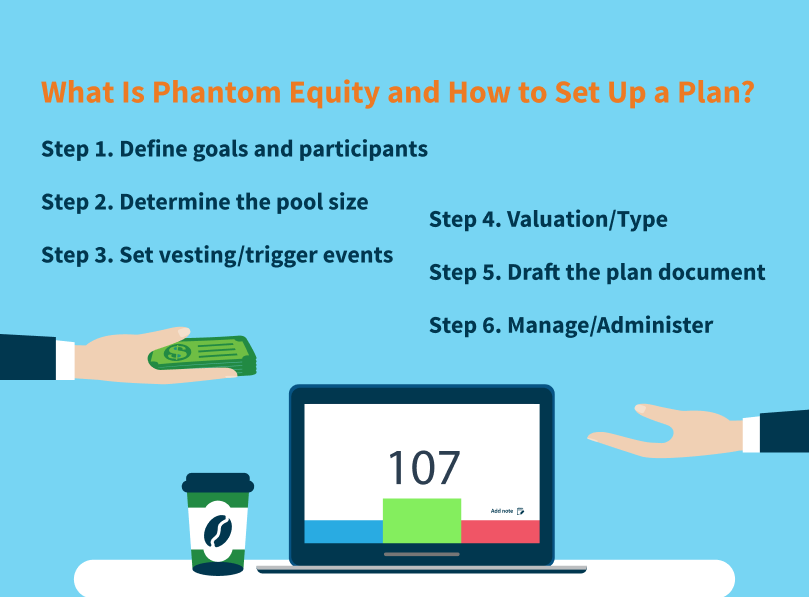
Determine who should receive these units: typically key executives or employees directly involved with company valuation.
Allocate a percentage (it can be company value at start) that ultimately splits with time—make it equal to account for dilution down the road.
Determine when units are earned (4-year schedule) and what trigger events will warrant payout—company sale/membership transition/IPO.
Merit Modeling helps organizations forecast compensation changes and simulate future reward scenarios, making it highly relevant when designing vesting schedules and estimating phantom stock payout obligations tied to performance or valuation events.
Obtain a valuation base where it assesses value for a 409A assessment.
Appreciation-Only rights pay out only on what's appreciated since granted.
Full-Value rights pay the entire value via payout at the time.
Draft it formally in writing or group agreements—to be signed and reviewed by legal counsel.
Identify someone (board of directors) who will administer the plan, manage it, track vesting and payout calculations down the road.
Governance means oversight by someone/a committee who will track vesting anniversaries and consistently do valuations for one year after each value important (quarterly/yearly).
Use compensation governance best practices to outline what should/will happen if rules written in documents are broken/determined unfair/legal disputes come up.
Manage by communicating news about payouts/trigger events and who/who does not get the payment throughout turnarounds (and terminations according to plan).
The biggest risks involved in creating a phantom stock plan are cash flow as payments come due (most in buyouts); taxes under section 409A could trigger a 20% penalty immediately if planning was done and goals not met; and litigation over vague time lines .
One case favored the employee in a $15 million lawsuit because they were denied what was owed during employment history following exit.
ERISA complications for too many people in a plan.
Valuation errors where too much payment occurs.
Employee dissatisfaction if values are lower than anticipated/certain materials are not clear regarding values.
Here are the common questions about the topic:
Of course, they can be extended beyond executives as any employee playing a key role could receive incentives.
Phantom equity awards deplete cash flow resources upon payment as they need cash, a good portion should be included when planning assets for certain situations.
They can be not so often as part of compensation discussions provides incentive for both parties to come to a conclusion.
Yes—they promote those in charge without diluting stakeholders/shareholders and give everyone the opportunity to benefit.
No, not typically nor unless specifically outlined in the plan’s death and disability clauses. Not even if there's offspring/benefactor expenses unless stated otherwise; it's nontransferable except personally within ones' employment history status with the company.

The latest research, expert advice, and compensation best practices all in one place.
Blog
Bringing trusted compensation intelligence and seamless planning to even more ADP users.

Blog
Learn how to train managers for effective pay conversations and build trust.

Blog
Total rewards package flexibility lets employees choose what matters - pay, perks, and benefits tailored to their needs.